
September 2025
When farmers are growing plants, they want to use water efficiently not to waste resources. However, the amount of water given to plants tends to depend on each farmer’s experience and intuition. Understanding the factors that control soil’s ability to hold water can help farmers make better decisions on how much and when to water plants. Specifically, many of these factors are still unclear for volcanic soil, which constitutes approximately half of Japan’s farmland. A research team led by FUJII Kazumichi (Unit Leader of F-REI Soil Homeostasis Research Unit) has identified short-range-ordered (SRO) minerals, such as allophane, as soil component that greatly influences the amount of water held in volcanic soil. Using this discovery, the research team has developed a new equation (model) that can more accurately estimate the amount of water held in volcanic soil. Published in Valdoze Zone Journal in September 2025, their findings also suggest that organic fertilizer can be useful to increase the amount of soil water that can be absorbed by plants (plant-available water).
Soil can be compared to a sponge: it can hold and release water. If soil contains mostly large pores (such as coarse sand), it loses water quickly through drainage. In contrast, soil that contains mostly small pores (such as fine clay) holds water better, but the small pores make it harder for plants to absorb that water. This ability of soil to hold water is called “water retention capacity.” Unit Leader Fujii’s research team found that high levels of SRO minerals are associated with increased proportion of small pores, which results in high water retention capacity. However, this finding suggests that high SRO mineral content decreases the amount of water accessible to plants. It means that even though volcanic soil retains a lot of water, little of it is available to plants.
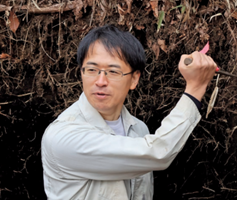
The researchers also discovered that higher levels of organic matter are associated with increased amount of plant-available water. According to Unit Leader Fujii, this finding indicates that “Adding organic matter may be useful for increasing the amount of water available to plants in volcanic soil.”
Unit Leader Fujii is enthusiastic of this work, “Previously, estimating soil water retention capacity is a time-consuming and labor-intensive process, but in this study, we successfully made an accurate estimation only by using data of soil constituents.”
As the Unit Leader of F-REI’s Soil Homeostasis Research Unit, Dr. Fujii aims to revitalize agriculture in Fukushima, starting by examining the balance of soil compositions. He added, “This is the study of soil homeostasis, and I believe it will serve as the foundation for restoring soil quality in areas with degraded soil.”
Original Article
Title: Critical roles of short-range-order minerals in shaping soil water retention curves in volcanic regions
Authors: Kazumichi FUJII, Chie HAYAKAWA, Takashi KOSAKI, Jan Frouz, Sukartiningsih
Journal name: Valdoze Zone Journal
First published: 17 September 2025
Available at: https://doi.org/10.1002/vzj2.70036